
21 Nov 2023
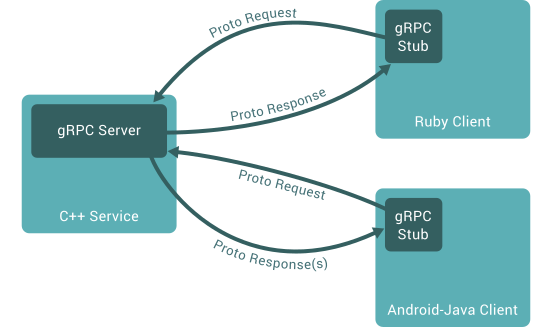
gRPC, which stands for "gRPC Remote Procedure Call," is an open-source remote procedure call (RPC) framework developed by Google. It enables efficient and secure communication between distributed applications. gRPC is designed to be language-agnostic, meaning it supports multiple programming languages, making it versatile for building cross-language and cross-platform services.
Key features of gRPC include:
-
IDL (Interface Definition Language): gRPC uses Protocol Buffers (
protobuf) as its Interface Definition Language (IDL). Protocol Buffers provide a way to define the structure of the data that will be sent between the client and server. This makes it easy to evolve APIs over time. -
HTTP/2 as Transport Protocol: gRPC uses HTTP/2 as its default transport protocol. HTTP/2 brings benefits such as header compression, multiplexing, and support for bidirectional streaming, making communication more efficient.
-
Support for Multiple Programming Languages: gRPC supports a variety of programming languages, including but not limited to C++, Java, Python, Go, Ruby, C#, and more. This allows developers to choose the language that best fits their needs for a particular application.
-
RPC Paradigms:
- Unary RPC: Traditional request-response model where the client sends a single request and receives a single response from the server.
- Server Streaming RPC: The client sends a single request, and the server responds with a stream of messages.
- Client Streaming RPC: The client sends a stream of messages to the server, and the server responds with a single message.
- Bidirectional Streaming RPC: Both the client and server can send a stream of messages independently, allowing for more interactive communication.
-
Code Generation: gRPC can automatically generate client and server code in multiple languages based on the service definition in the Protocol Buffers format. This simplifies the development process and ensures consistency between the client and server implementations.
-
Pluggable and Extensible: gRPC is designed to be extensible and allows developers to plug in their own authentication, load balancing, and other features.
gRPC is commonly used in microservices architectures, where services need to communicate efficiently in a distributed and scalable environment. It provides a modern and efficient alternative to traditional RPC frameworks, and its use of Protocol Buffers for serialization and the support for various RPC paradigms make it a powerful tool for building distributed systems.
